Physicist Ethan Thompson joins Transformer Lab as Lead Research Scientist, Quantum Science
We’re excited to announce that Ethan Thompson, a theoretical physicist who worked on quantum field theory at the Perimeter Institute for Theoretical Physics, has joined Transformer Lab.
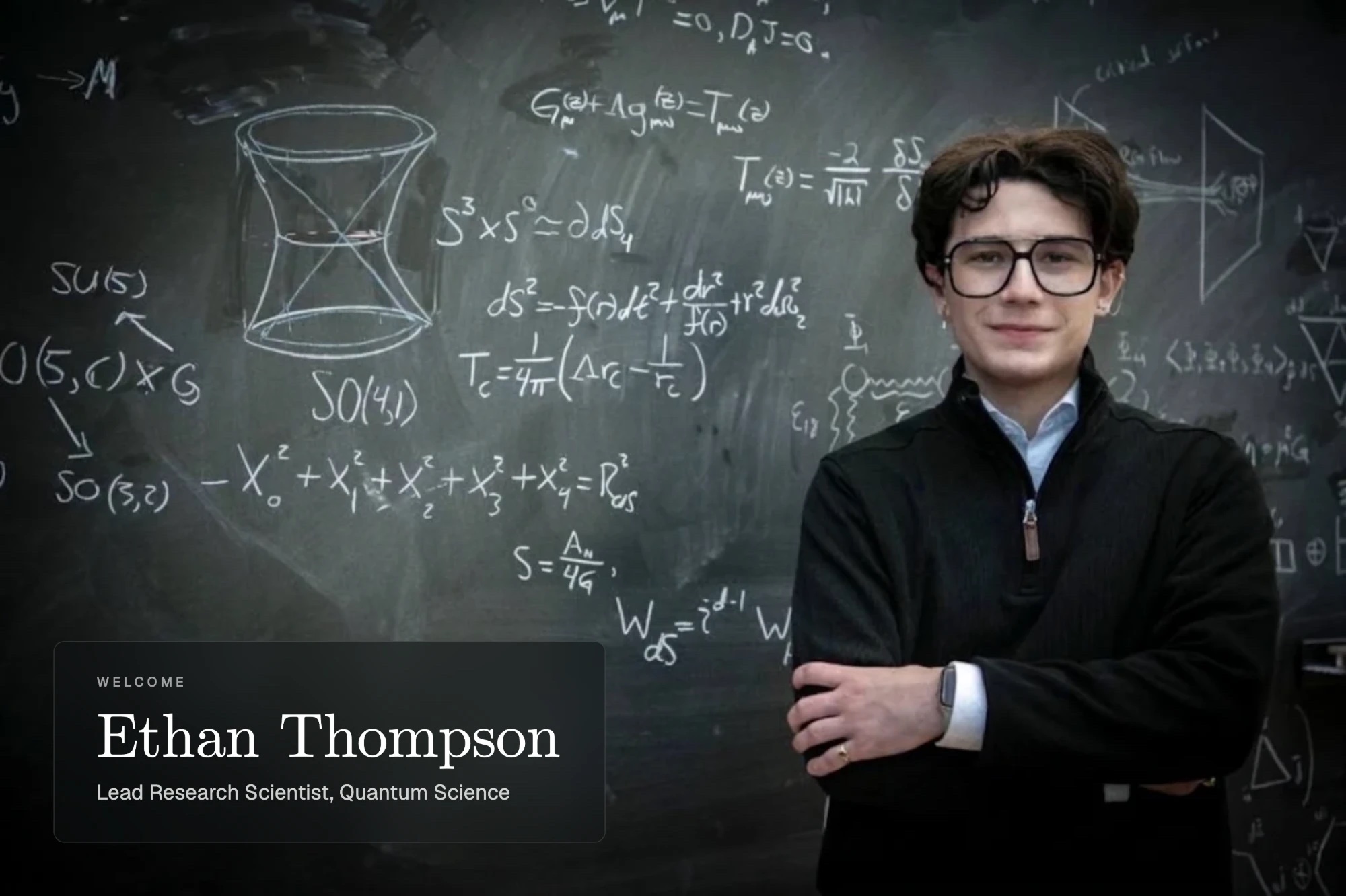
Ethan will serve as Lead Research Scientist, Quantum Science, leading our work with physicists, quantum research groups and the institutions that support them. He will help advance Primus, build collaborations with academic and industrial research teams, and develop methods for ensuring that AI-generated scientific results are verifiable, reproducible, and useful to working researchers. He will also contribute to discussions about the responsible use of AI in scientific research and the policies that will shape its adoption.
Ethan brings the perspective of a working theoretical physicist to the development of Primus, helping ensure that autonomous AI systems are evaluated against the same standards of mathematical correctness, experimental evidence, and reproducibility that are key to scientific discoveries.
At Perimeter, Ethan has worked closely with his supervisor, Professor John W. Moffat, modifying Moffat's long-running program of finite, nonlocal quantum field theory to make it more suitable for our universe. Moffat is professor emeritus of physics at the University of Toronto and a resident senior research affiliate member of Perimeter Institute. He first proposed finite, nonlocal quantum field theory in 1990. He is known for his work on modified gravity and on a variable speed of light in the early universe, and for corresponding with Albert Einstein about unified field theory in 1953.
Ethan's contributions span the theory and experiment of quantum science. His research asks whether our current understanding of quantum mechanics and spacetime is complete. Much of his work focuses on nonlocal quantum field theory, which explores the possibility that particles and interactions cannot be localized to exact points in space and time. In a paper published in Annalen der Physik, he derived a modified uncertainty relation suggesting that physical localization has a fundamental limit, extending the usual Heisenberg uncertainty principle. Working with physicist John W. Moffat, he has also investigated whether quantum mechanics itself should be understood as fundamentally nonlocal, rather than locality being an exact property of nature. His current research aims to bring these questions into the laboratory, exploring how thorium-229 nuclear clocks and nuclear measurements could test predictions of nonlocality. The broader goal is to connect foundational questions about quantum theory and the structure of spacetime with experiments capable of distinguishing competing physical theories.
“I’ve admired Transformer Lab’s progress on building trustworthy and capable AI systems,” said Ethan. “I believe autonomous AI collaborators will greatly broaden what a single researcher or a small lab can take on. This is definitely the case in fields like quantum science, where people fluent in both theory and the experiment are scarce. I’ll work to ensure that Primus is a true collaborator for researchers, and that its results are verifiable and traceable, helping researchers and students build their own research judgment faster.”
“Ethan’s background in theoretical physics at Perimeter Institute strengthens our research team and will help us bring Primus to the physicists and quantum research groups working on some of the hardest problems in science. We’re fortunate to have him leading this work,” said Ali Asaria, Co-founder of Transformer Lab.
Researchers, institutes and policymakers working on AI for quantum science can reach Ethan at [email protected].