Research
Research from the Transformer Lab team.
37 articles

How far can you get on R(5,5) with proofs you can check by hand?
We prove bounds on the diagonal Ramsey number R(5,5) by certificates short enough to check by hand, using a symmetry reduction for Paley graphs and classical counting arguments. Specific results that we prove include: the clique number of the Paley graph of order 37, from one dis…

How much entanglement does it take to tell four twisted Bell states apart?
We determine the optimal probability of correctly discriminating the four orthogonal two-qubit states α|00⟩ + β|11⟩, β|00⟩ − α|11⟩, α|01⟩ + β|10⟩ and β|01⟩ − α|10⟩, given with uniform probabilities together with an ancillary pair of qubits in the state √((1 + ε)/2)|00⟩ + √((1 − ε…

Why AI-Text Detectors Disagree About Who Cheated
A recurring claim in machine-text detection is that detectors, however different their construction, all read a single underlying axis: post-training style, alignment, or statistical typicality. If true, detectors are interchangeable and their disagreements are noise. We show fir…
We brought Mamba to Trainium — and mapped where custom kernels actually help
An autonomously-conducted study of where custom Neuron-Kernel-Interface (NKI) kernels pay off on AWS Trainium 1. At the operation level, a fused NKI RMSNorm kernel is 1.57x faster than a naive un-fused baseline (112 vs 176 µs at Llama-3.1-8B width), bit-exact, and roofline-consis…

When can an AI improve its own math by grading itself?
Reinforcement learning without a ground-truth verifier, using self-consensus signals such as majority vote, improves some base language models on math reasoning and does nothing for others. The common explanation attributes the difference to base math ability. We show instead tha…

Is skipping zeros free on a wafer-scale chip?
Wafer-scale engines keep model weights resident in on-chip SRAM, which suggests that the memory-bound decode matrix-vector product (GEMV) at the heart of autoregressive inference might turn compute-bound, and that unstructured weight sparsity might translate into proportional cyc…

We made LLMs play co-op games to show how to detect lying by comparing words, actions, and neurons
If we want to trust what a language-model agent says about its own strategy, we need to know when the report is faithful. We instrument an agent with three synchronized read-outs of its strategy: its behavior (the action it takes), its narration (what it states its strategy is),…

When Will More Thinking Help a Reasoning Model? Ask the Cheap Eval First
Evaluating reasoning models at large per-response thinking budgets is expensive, so practitioners would like cheap low-budget evaluations to stand in for them. We show that a probe restricted to at most 4k thinking tokens per response can reliably answer the practitioner's operat…
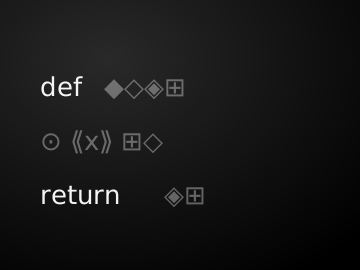
Two Kinds of Unreadable: what obfuscating code actually costs a language model
A recent report claimed that making code unreadable, by replacing familiar syntax with alien glyphs, improves a frontier model's accuracy on hard programming problems by tens of points. We do not reproduce any such benefit on five models spanning 7B to frontier scale. Holding eac…

The crystal-structure advantage in materials AI is real, not leakage
Structure-aware graph neural networks (GNNs) beat composition-only models on the Matbench materials-property benchmark, often by large margins. A common suspicion is that this advantage is inflated by benchmark leakage, near-identical crystals shared between train and test, so th…

A chatbot hallucinates secrets it can't know. A world model built from the same base won't.
A language world model simulates an environment by predicting, in text, the observation that follows an action. To be trustworthy as a substrate for planning, such a model should signal when it cannot know what an environment would return, rather than invent it. We test this on Q…

Reusing a training-difficulty score across runs: when it holds up and when it doesn't
Compute-allocation schemes that steer extra training budget toward high-value examples need a per-example value or difficulty score, and a practical design choice is whether that score must be recomputed online, in-loop, during the run it steers, or can instead be pre-scored once…

Can you remove political censorship in Chinese open weight LLMs?
Open-weight LLMs from Chinese labs increasingly rank among the strongest available, but they carry embedded political guardrails: on topics such as Tiananmen, Xinjiang, and Taiwan they deflect, hedge, or restate the official line. The natural tool for removing such learned behavi…

More Canadian than American: the surprising default values of five leading AI models
Language models are widely assumed to default to American values. We test that assumption by comparing five instruction-tuned models' answers against the survey-measured opinions of real United States and Canadian respondents, and find the opposite: every model we tested aligns m…

The Copy Test: How Much of a Foundation Model's Skill Is Already in the Obvious Answer?
Zero-shot foundation models are increasingly applied far from language, in time-series forecasting and single-cell genomics, on the promise that large-scale pretraining lets them solve new tasks in context. We ask how much of that apparent skill, measured at the score level, a ch…

Does a reasoning model have a subconscious? A plain lens says probably not
The Jacobian lens transports a residual-stream vector into the final-layer basis with the average input-output Jacobian, $lens_l(h)=unembed(J_l h)$, reading the tokens a model is silently disposed to say later; the resulting "J-space" has been proposed as an emergent workspace. R…

You can't scale a learned physics simulator out of blowing up
Graph-network simulators learn to advance particle-based physics one step at a time, but their autoregressive rollouts accumulate error and eventually blow up. We ask a practical question: among the interventions commonly proposed to stabilize such rollouts, which actually help,…

How much can you cut off a 3D shape before it can't grow back?
Neural Cellular Automata (NCA) learn a single local update rule, shared by every cell, that can grow a target pattern from a seed and repair it after damage. This behavior is well studied in two dimensions but its three-dimensional counterpart, and in particular the robustness of…

It's the language, not the lab: the prompt language, not the model's origin, is what shifts its framing on contested topics.
As open language models from many countries enter wide use, understanding what shapes the values they express becomes practically important. We study this with a clean design: how much of a model's stance on contested topics is set by where it was built, and how much by the langu…

The best-sounding open-source music generator is also the only one you can steer
Vendor reports for text-to-music models rank systems with Frechet Audio Distance (FAD) and CLAP score computed on a single CLAP encoder, the same family a model may be trained against, raising a circularity concern. We ask two questions about three open-source instrumental genera…

Everyone assumes bigger AI models win. We built a 34,000-parameter earthquake detector that beats a model 8× its size.
Deep neural pickers such as PhaseNet and EQTransformer are the default tools for detecting P- and S-wave arrivals, but they carry hundreds of thousands of parameters and are usually benchmarked on randomly split data, where near-duplicate windows of the same event leak between tr…

Reasoning models don't have much trust in their own thoughts
Reasoning models write a chain-of-thought (CoT) before answering, and that trace is increasingly read as an explanation. We ask whether the answer's probability actually depends, under intervention, on the reasoning steps, and whether this differs when the reasoning is provided t…

Scaling a protein model is what lets RL beat trial-and-error protein design
A deliberately fair, matched-query-budget comparison of GRPO reinforcement-learning fine-tuning of a protein language model (ESM-2) against classical directed evolution on the GB1 four-site fitness landscape, using an exact-lookup oracle (nothing to game), a strong simulated-anne…

What's the best way to run a 30B coding model on a 24 GB Mac?
Asks whether a 30B-total / 3B-active MoE coding model (North-Mini-Code-1.0, 128 experts, top-8, Apache-2.0) can be quantized to beat its vendor 4-bit while still fitting a hard ≤24 GB Apple Silicon budget — and finds round-to-nearest (RTN) 4-bit is the ceiling, a careful negative…

Does fine-tuning a chatbot make it more brain-like? We checked
Reports that instruction-tuned models are more "brain-aligned" than their base versions are mostly a chat-template artifact, not a property of alignment training. Under identical raw text, post-training weight changes leave fMRI encoding alignment essentially unchanged (Qwen base…

When an AI searches for the equation behind your data, one dial steers it
A mechanistic study of how an RL objective shapes symbolic-regression search: the parsimony coefficient λ cleanly and monotonically sets the operating point on the accuracy–parsimony frontier, while the DAPO clip-higher asymmetry does not — it is the entropy regularizer, not the…

Training an AI to be correct collapses its variety
Verifiable-reward RL (RLVR) for procedural Sokoban-level generation triggers a sharp reward↔diversity phase transition: the model mode-collapses to one or two level templates (distinct-valid fraction ≈1.0 → <0.05) across three trust-region objectives (PPO, DAPO, DPPO), seeds, and…

How modular is a frontier Mixture-of-Experts?
A pre-registered causal test of whether the experts in a frontier MoE (Command A+, 218B total / 25B active, 128 experts) form functional modules tied to capabilities or languages. Of six pre-registered expert families ablated at inference time against a size-matched random-expert…

Teaching a language model to say "I'm not sure" using its own doubt
A model's own token-probability "doubt" signal, used to decide when to abstain, matches label-supervised abstention-tuning without using any correctness labels. Across six open-weights models (1B–8B, two families) on short-form QA, the label-free LoRA recipe shows no statisticall…
How I built my own Tesla-style self-driving AI
A DINO-pretrained ViT-S is competitive with a pretrained ResNet-50 at end-to-end steering-angle prediction on a small slice (~5–16k frames) of the comma2k19 driving dataset — turn-slice Pearson 0.964 vs 0.967. Competitiveness is conditional on adaptation (low-LR full fine-tuning,…

Judging to improve: a 3D judge you can train against, and the limit of cheap 3D specialization
A trainable, de-biased VLM-as-judge for single-image 3D generation — one VLM family labels training pairs, a different family scores, and verdicts only count when they survive an order swap. Used to test cheap label-free adaptation of a strong base: six methods reach only parity…
Train, retrieve, or both? What it takes to make a language model cite the law correctly
A four-arm head-to-head (base, LoRA SFT, RAG, SFT+RAG) for correct statutory citation on Ontario tenancy law. The base model hallucinates 81% of its citations; retrieval is the decisive lever, driving hallucinations to zero by construction and lifting citation exact-match to 0.44…

Judging single-image 3D generation without humans (and why cheap proxies fall short)
A standardized evaluation protocol for single-image-to-3D mesh generators, using 24-view rendering and position-bias correction — and showing that common proxies like CLIP similarity and geometry-validity metrics don't substitute for a VLM judge.

A Universal Post-Training Improvement for Open Audio Models
ASR-based self-verification drives catastrophic failures (silence, early termination, repetition) to near zero in autoregressive neural-codec TTS, then distills the behavior for inference-time efficiency — generalizing across four TTS systems and three codecs.

Neither parallel nor sequential: how DiffusionGemma actually commits tokens
A close look at token-commitment patterns in DiffusionGemma 26B. Contrary to parallel-decoding marketing, the behavior is neither parallel nor block-autoregressive — weak left-to-right bias and substantial within-batch ordering ambiguity.

Making INT8 actually fast: a fused kernel for Ideogram 4 on a 3090
A fused Triton kernel that properly drives the INT8 tensor cores on consumer Ampere GPUs — ~1.1× end-to-end speedup, making 1024px generation feasible on a single RTX 3090.

Quantizing Ideogram 4.0 onto a 3090: an INT8 build that matches FP8 and a 4-bit GGUF that beats NF4
Post-training quantization of Ideogram 4.0 where INT8 W8A8 comes out statistically indistinguishable from FP8 on key quality metrics, with INT8 and GGUF Q4_K both cutting compute for consumer-GPU deployment.